January 6, 2025

By Ronald Hadley (ronald.hadley@biztipstoday.com). Photo by Freepik
Today’s businesses are increasingly recognizing the importance of sustainability not just as a trend, but as a fundamental component of their operations. Crafting an eco-friendly business model is not only a moral imperative but also a strategic advantage that can drive growth and profitability. By integrating sustainable practices into every facet of your business, from operations to marketing, you can create a resilient model that appeals to environmentally conscious consumers. This article delves into practical strategies that can help businesses thrive while making a positive impact on the planet.
Strategic Benefits of Forming an LLC
When starting your eco-friendly business, forming a limited liability company (LLC) can be a wise decision. An LLC offers limited liability protection, safeguarding your personal assets while providing tax flexibility that supports sustainable growth. Additionally, LLCs typically require less paperwork and offer more operational flexibility than corporations. It’s essential to understand the specific regulations in your state. For example, if you’re considering forming an LLC in Colorado through ZenBusiness, familiarize yourself with Colorado’s requirements. This strategic move not only protects your personal assets but also positions your business for long-term success and a positive environmental impact.
Digital Tools for Eco-Friendly Marketing
Leveraging digital platforms is a powerful way to minimize reliance on traditional marketing materials. By engaging with a global audience through strategies like social media marketing and email campaigns, suggests Sprout Social, you reduce costs and contribute to environmental conservation. This approach aligns with the growing focus on sustainability and enhances customer interaction by reaching them online. As the digital landscape evolves, adapting to these changes can give your business a competitive edge while lowering its carbon footprint.
Sustainability Audits
Conducting regular sustainability audits is vital for aligning your business with environmental, social, and governance (ESG) standards. These audits help identify strengths and areas for improvement, ensuring alignment with industry benchmarks. By systematically assessing your company’s practices, you can track key performance indicators (KPIs) and drive continuous improvement. Utilizing tools like KPI dashboards can streamline the audit process, enhancing efficiency and effectiveness. Regular audits act as a proactive measure to mitigate potential risks and bolster your business’s eco-friendly model.
Eco-Friendly Design
Incorporating eco-friendly design principles can significantly enhance sustainability throughout your product’s lifecycle. By focusing on Ecodesign, you can evaluate each stage of the product’s life to minimize environmental harm. This involves selecting materials with a low environmental footprint and employing innovative manufacturing techniques to reduce emissions. Adopting circular design strategies, such as using recycled materials, helps keep resources in circulation. Aligning these practices with your corporate strategy not only contributes to environmental sustainability but also engages customers in meaningful ways.
Sustainable Packaging
Incorporating sustainable packaging into your business model minimizes environmental impact and enhances your brand’s appeal to eco-conscious consumers. Through implementing reusable and refillable packaging systems, you can significantly reduce single-use waste. Highlighting these sustainable choices in your marketing materials can differentiate your brand, build trust, and drive growth by showcasing your commitment to environmental responsibility. This approach aligns with stricter EU sustainability regulations and taps into the growing consumer demand for eco-friendly products.
Research Collaborations
Forming strategic partnerships with educational institutions can drive sustainable innovation and enhance your business model. Universities are hubs of cutting-edge research, providing opportunities to access the latest advancements in sustainable technologies. These collaborations enable you to harness academic expertise to develop eco-friendly solutions that align with your corporate objectives. By investing in academic research, you contribute to societal progress and gain a competitive edge by integrating sustainable practices into your business model.
Pursuing an eco-friendly business model is a strategic choice that aligns with both ethical values and market demands. By adopting these strategies, businesses can not only contribute to environmental preservation but also achieve sustainable growth and profitability. As the world increasingly values sustainability, those who lead with eco-friendly practices will set themselves apart and inspire others to follow suit.
Discover how Guild Creative can elevate your brand with innovative marketing solutions tailored for small businesses. Visit their website to see how they can help you stand out and succeed!
November 22, 2022
Google is a powerhouse. In fact, Google is responsible for 94% of total organic traffic. Surprised? Probably not. Google is likely the first place you turn when you need to find a business, product or service near you. And, if it’s the first place you turn, where do you think your customers turn? The odds are good that they turn to Google as well. So why not take advantage of that knowledge and leverage a powerful, and free social media and marketing tool offered by Google – Google My Business.
Think of Google My Business as a way to share information about your business when your customer is searching for it. Pretty amazing, right! There are very few “must have’s” in the world of social media and marketing. Google My Business however, is a must have, and here’s why.
Show Up In Google Search and Maps
When your Google My Business account is fully populated with your business details (website, address, phone, hours open, services, etc.), your business will show up more frequently in both search and maps. Showing up in search means your potential customers have more opportunities to visit your website, call you or stop in to your physical location.
Learn Customer Insight
Customers like to leave reviews. And, potential customers like to read the reviews of your current customers. With Google My Business, customers can leave reviews about your business directly on your account. And, once you claim and verify your listing, you have the ability to respond to their reviews, whether they are good or bad! It’s an instant way to begin a conversation, and understand what your customers are truly saying about your business.
Understand Searches
Within your Google My Business account, there is a great section called Insights. This section provides a wealth of knowledge including how customers search for your business and what search queries were used to find your business profile. This information is like marketing gold! If you know the words/phrases that customers are using to find your business, you can use those words/phrases more in your content marketing strategy, and potentially drive additional traffic to your website.
Feature Products, Services and Photos
Because your Google My Business account is your business profile, you are able to (and should) post updates about your business. And, they can be self-promotional! For example, you can share details on a new product or service, an upcoming event, a sale or any other business update that you may have. And what’s more is that you can include a corresponding photo, and a link back to your website, or offer a click to call opportunity.
The bottom line is that creating a Google My Business account is free, easy and the benefits can be exceptional for your business. If you haven’t claimed your account yet, do it as soon as possible. If you’ve claimed it and haven’t leveraged it yet, do that now! The more you add in terms of business information, and share with your audience, the more you will get out of it.
And if you need a bit more help with your marketing plan, contact us. We can help develop a customized social media and marketing plan based on your goals, and your budget.
This is a guest post from Kristen Davis, CEO & Founder of Athenian Marketing.
February 16, 2022

After two decades online, what have we learned about website design and development?
Web website design and development has come a long way in the past 20 years. Through trial-and-error, evaluation, experience and sophisticated research, experts have begun to get a grasp on what works. Website design and development need to be visually pleasing, engaging, and brand aware while instilling credibility.
While the appearance of a website is important, recent studies have concluded that 80% of users value function over aesthetics. The efficiency and flow of the site must engage a customer, pulling them along an organic journey with no speedbumps. The site also needs to be functional for your company as a brandingand marketing tool. What are your website goals? Do you want your site to help you acquire information, increase sales, or accumulate qualified leads? Let’s take a look at what we consider is the ideal mix of aesthetics and functionality for a successful website.
25%: Aesthetics—Easy on the eyes. Inviting to the brain. Effectively instilling brand confidence and recognition.
Let’s take a trip back in time to the dot-com boom; the early days of Yahoo! and eBay. Those were the days of cheesy clipart, textured backgrounds, ridiculously bright color schemes, and all the text. Oh, and let’s not forget the overuse of Comic Sans font. Maybe it was the simplicity of the structure of websites at the time, but the focus definitely seemed to be more on “cool” graphics than an engaging, welcoming, and pleasing user experience.
Here in the 21st century, we strive to ensure companies get a website that grabs the attention of users by communicating a compelling brand image. Using data-based marketing and branding, companies are able to target more specific audiences and appeal to them with a more personalized user experience. How a website looks
75%: Functionality—Navigation, Information Architecture, Graphic User Interface, and Marketing Objectives.
Internet users are somewhat picky when it comes to the navigation of websites. Most of the time, a user doesn’t want too much information on one page, but they also don’t want to have to do a lot of clicking to find what they are looking for. So, many companies struggle to organize their site in a way that allows customers to quickly locate the exact products or information they want, without overloading users with too many menus or too much text.
Insights taken from the data within your site, as well as the industry as a whole, can help to create a user experience that is easy and will keep them coming back. We can use SEO data to know how your customers are searching for and finding you, as well as how they interact with your site. Knowing what is important to potential customers not only allows you to set up pages efficiently, but can also provide some crucial information about your products and services from the customer perspective.
Conversions, Transactions, and Sales…Oh My!
A website is simply a hub for companies and customers to exchange resources. Your users come to your site in hopes of getting information, products, or services. You want to get the sale, an email address for future communication, or simply some data. A successful visit means everyone walks—err, clicks—away with something.
In the modern, digital age, a company can choose to track pretty much any kind of interaction to track in order to learn how their customers use a site and where they are possibly losing users. If a file download or form submission is faulty or even just inconvenient, that’s a common place for users to drop off and abandon one site in favor of something easier to use. If a cart checkout lags or appears to stall out, credibility comes into question. Once a user ends their session due to functional problems, both user and brand are left unsatisfied with the exchange.
Finding balance between design that is engaging while still being easy to use can seem like a daunting task. With a strong grasp on best practices and resources to create a winning strategy, we can help you rise to the top of the search results and the industry.
Website design and development.
Contact today to learn more about website design and development. 262-6573-3714..Ask for Steve!!!
July 15, 2019
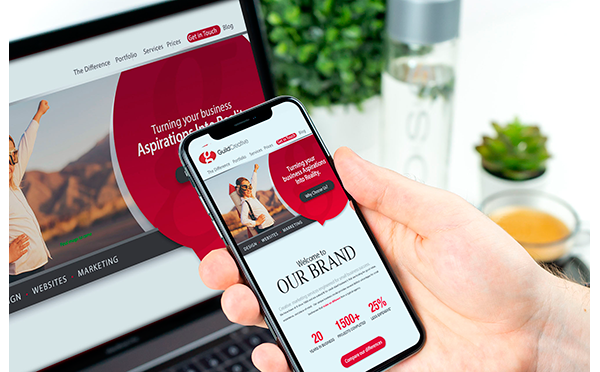
Don’t make Google unhappy!
A mobile-friendly website is no longer an option; it’s a requirement. This isn’t new – we’ve known for years that more and more people are using mobile devices to browse and search online.
The next time you’re sitting in a busy coffee shop, airport, or shopping mall, take a look around and see how many people are quietly staring at their phones. Chances are, you’ve already taken notice. Not since the creation of the television has our society been so captivated by a piece of technology as we are by the smartphone. The amount of information, entertainment, shopping, and other resources available at a user’s fingertips has made mobile devices almost a necessity for some people.
Since 2017, web traffic to all sites from mobile devices has hovered around the 50% mark. That means about half of your customers are likely seeing your site from their phone. Without mobile-friendly, responsive design, the user experience could actually be driving those valuable customers away as they choose to save the search until a computer can be used.
What is responsive website design solution?
Responsive web design (RWD) is an approach to website creation that customizes the layout, appearance, and functionality of a given site or page to the specific device and orientation or window size the user is operating. Text, images, menus, and forms automatically resize and rearrange to provide the best user experience. The need for zooming or scrolling side-to-side is eliminated, allowing customers to jump right into the content they’re looking for in a more customized and personalized web environment. In addition to providing a better user experience, RWD is significantly more cost effective than designing and maintaining a desktop and mobile website.
“But my customers don’t really use mobile devices, and prefer computers”.
This could be a very accurate statement, and data can certainly prove that web traffic to your site does not hit that 50% mobile device statistic. However, there are two factors that could be keeping mobile users away from your site. First, the user experience on smartphones or even tablets could be a reason for a high bounce rate. It’s possible how your images and text are rendering is an immediate call for a laptop or desktop, and potential customers are abandoning their visit. Google algorithms actually give mobile-friendly sites a bump up in the search results list. Your competitors could actually be stealing your spotlight before customers scroll far enough down the list to find you.
So how do my company and customers really benefit?
In 2016, 36.6 million internet users were accessing the web exclusively from mobile devices. In 2021, that number is predicted to increase to 52.3 million. How many of those customers would you like to see enter your sales funnel? Responsive design can expand your reach to those who prefer the smaller devices. For all customers, existing and potential, a consistent experience across all devices can actually increase leads and sales. Also, designing with mobile visits in mind can help to streamline content in order to really focus on what is most impactful. Your teams actually save time and money on managing the content as well as analyzing and reporting results. CTA Responsive sites are where it’s at—and where your site should be at as well!
Call Steve to get your site responsive and mobile ready–262-677-4696.


